Agency operations | Pix2Code Editorial
How Agencies Protect Margin When Content Demand Keeps Growing
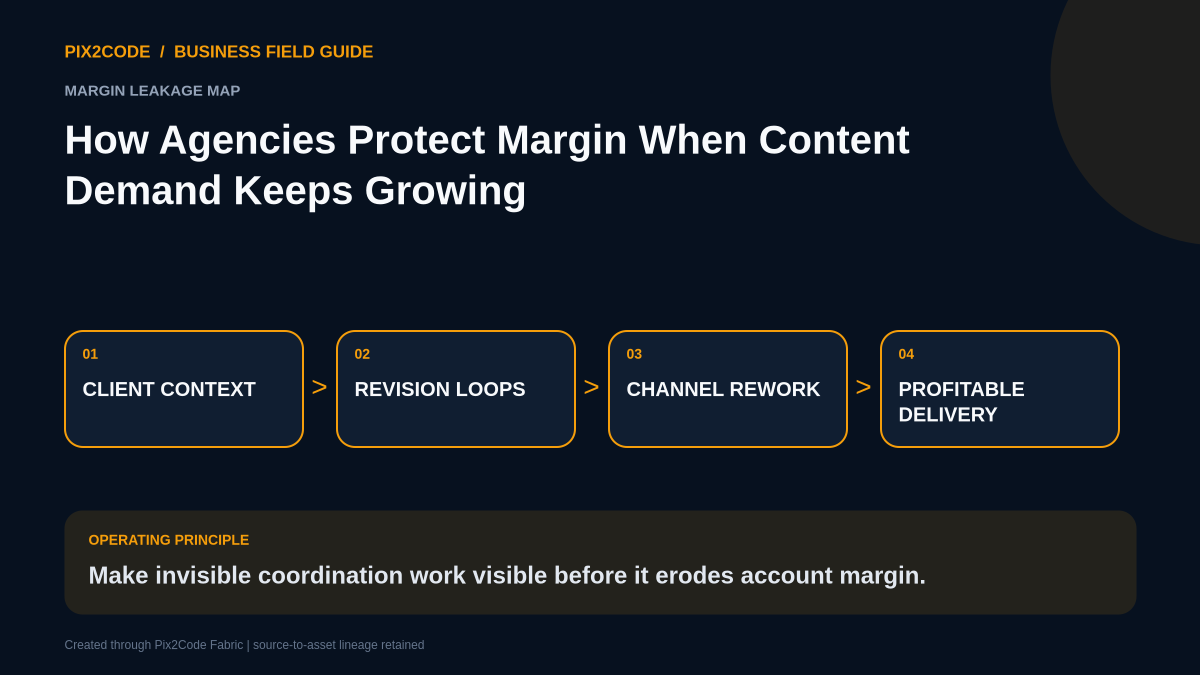
Why can a growing agency account produce surprisingly less profit?
Demand rises, but the fee often stays fixed. Teams absorb extra formats, channel versions, and late client changes. Those unpaid hours turn account growth into margin loss. The gap is easy to miss because top-line revenue can still look healthy.
Agency COOs, managing directors, delivery leads, and client service teams need a clear view of that hidden work. The goal is not simply more content. It is more profitable content.
Find the Work That the Fee Does Not Cover
Start with the gap between the work sold and the work done. A scope may include one core asset and two review rounds. The team may end up making six channel versions and handling four rounds of notes. If no one records that change, the account report hides the real cost.
This is why revision labor is hard to price. The work arrives in small pieces. One comment takes ten minutes. A new crop takes twenty. A late legal note sends three files back through review. Each task seems minor, but the full set can erase the planned agency profit margin.
A useful review starts with three facts:
- What did the signed scope include?
- What work did the team actually perform?
- Which changes came from the agency, the client, or a new channel need?
These facts make scope talks fair. They also help the agency price the next brief with real data instead of guesswork. The key insight is simple: work that stays hidden cannot improve the next price.
Put Client Proof and Approval in One Trail
Client notes often live in email, chat, calls, and review tools. The team then has to rebuild the decision each time work moves to a new person. A designer may act on an old note. A producer may not know that legal already approved a claim. The result is more review and more risk.
Enterprise content research lists approvals, team alignment, resources, measurement, and distinct content among the issues that firms face. The research does not prove a fixed savings rate for any agency. It does show why approval work belongs in the operating model, not at the edge of it. Read the enterprise content research.
A sound approval trail should answer simple questions. Who made the call? What did they approve? Which source or rule backed it? When does the approval expire? Which asset and version does it cover?
The strategy is to keep those answers with the work. Do not force the next team member to search five tools for them. This step cuts avoidable review while keeping human judgment in charge.
Reuse Context When the Channel Changes
A channel version should not restart the whole creative agency workflow. The core claim, client voice, proof, rights, and past approval still apply. The format may change, but the source facts should travel with it.
For example, a long client interview may support a blog post, a LinkedIn clip, and a sales page. Each output needs its own length, pace, and call to action. Yet all three should point back to the same approved source. If the source link is lost, each team must check the claim again.
Good agency content operations split stable context from channel rules:
- Stable context includes the audience, offer, proof, rights, brand voice, and approved claims.
- Channel rules include size, length, caption style, safe areas, and the desired next action.
That split lets the team adapt work without losing the reason behind it.
Representative Example: A Campaign That Looks Profitable
Consider a made-up but common agency account. The team sells a campaign page, a short video, and three social posts. The first draft is on time. Revenue and delivery status both look sound.
Then the client asks for two new buyer groups. Sales wants a new proof point. Legal changes a line after the video is cut. The social team also needs two more sizes. No single request looks large, so the agency accepts each one.
At the end of the month, the account still shows more revenue. But the team has spent far more time than the plan allowed. The creative lead worked late, the producer moved staff from another job, and the editor made work that was never priced.
The lesson is not to reject every change. The lesson is to show the cost and make a clear choice. The agency can use a change order, trade one task for another, or accept the work as a planned investment. What matters is that the choice is seen and recorded.
Questions for an Account Review
Use these questions in a monthly account review:
- Can we tie each review round to a brief, a client request, or an internal fix?
- Can the team find the latest approved claim without asking in chat?
- Do channel versions reuse the same source facts and rights notes?
- Which roles spend the most time rebuilding lost context?
- How much work was added after scope approval?
- Which changes should affect the next quote or schedule?
- Did fast delivery create more fixes later?
- Can finance see the cost of approved work, not just the count of files?
The aim is not to watch each minute. It is to find repeat work that no one chose or priced.
A Decision Table for New Workflow Tools
Do not buy a tool because it makes one task look fast. Test whether it helps the team protect margin across the full job.
| Problem | What to Measure | What the Tool Must Show | Buying Question |
|---|---|---|---|
| Unpaid revisions | Hours and rounds beyond scope | Version history and the source of each request | Can we see which changes were client asks, internal fixes, or channel needs? |
| Scattered approval | Time spent finding the latest decision | One approval trail tied to the right asset version | Can a new team member find the approved claim and its proof? |
| Context reset | Time spent rebuilding the brief for each channel | Shared source facts plus clear channel rules | Does context move with the work when the format changes? |
| Weak margin view | Planned hours compared with actual work | Cost by approved campaign and major review stage | Can delivery and finance use the same facts? |
This test keeps the buying process tied to the creative agency workflow. It also makes vendor claims easier to check.
Measure Profitable Flow, Not File Counts
Output volume is a weak measure of agency health. Ten files may come from one clean decision or ten rounds of rework. Leaders need measures that show how work moved and why.
Useful measures include cost per approved campaign, time from brief to approval, review rounds, unplanned hours, reuse rate, and time spent rebuilding context. None of these proves profit on its own. Together they show where margin may leak.
Review the measures by account, work type, and stage. A slow legal review needs a different fix from a weak brief. A high reuse rate may be good, but not if each version needs a full new approval. The numbers should lead to a clear operating choice.
Where Pix2Code Fits
Pix2Code presents its agency workflow as connected audience research, content work, and campaign-ready creative rather than a set of isolated generators. See the Pix2Code agency solution.
That approach is relevant when an agency wants source facts, edits, approvals, and channel outputs to stay linked. It does not remove the need for client review or sound pricing. It gives the team a way to keep the decision trail with the work and test whether each change improved the result.
Build an Agency Margin Leakage Map
Choose one live account and map it from brief to final approval. Mark each review round, added format, lost source, and late handoff. Note who did the work and whether the fee covered it.
Then pick the largest repeat cost. Fix that point before adding a broad new system. The answer may be a clearer scope, one approval owner, a shared proof record, or a better channel brief.
Repeat the review after the next campaign. A useful agency content operations process should make the work easier to trace, price, approve, and learn from. If it only increases the number of files, it has not solved the margin problem.