Content operations | Pix2Code Editorial
Why a Content Supply Chain Needs Orchestration, Not Another Point Tool
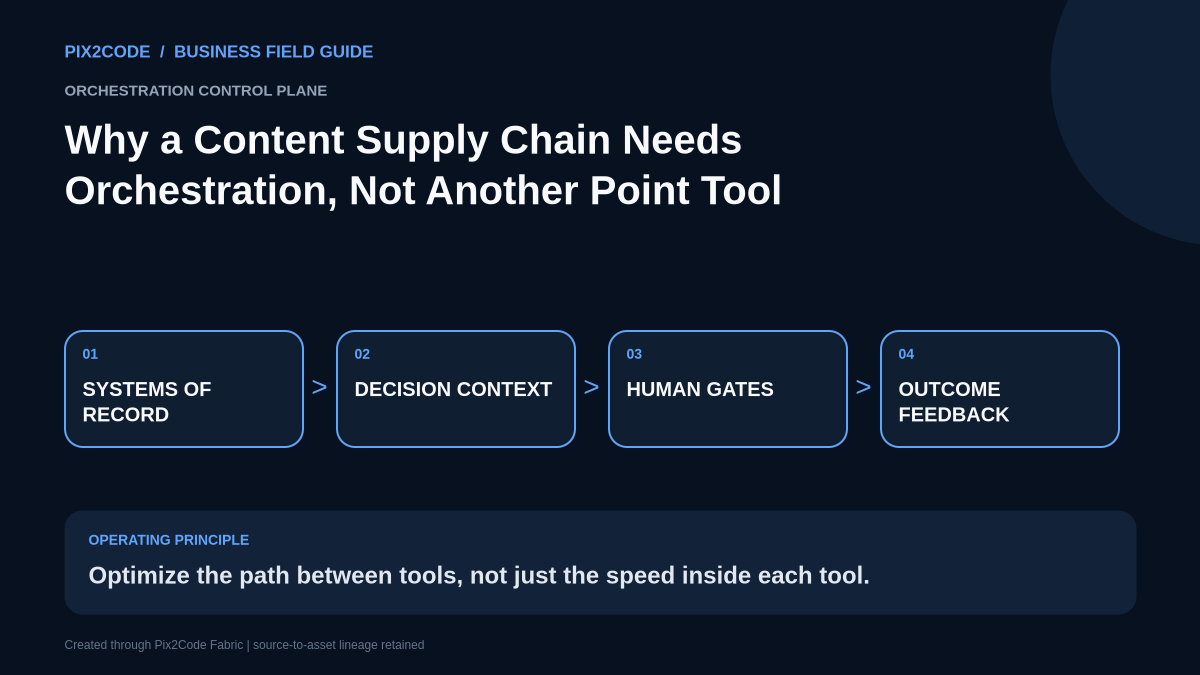
Orchestrating Your Content Supply Chain: Beyond Point Tools
Marketing and creative operations leaders face a critical decision: how to scale content production without multiplying complexity. The immediate urge is often to add specialized tools. While these point solutions promise faster local steps, they frequently slow down end-to-end work. This creates more handoffs, duplicate metadata, unclear ownership, and significant context loss across the entire campaign lifecycle. This fragmentation directly impacts your content supply chain efficiency.
We visualize this business moment as teams adding specialized tools. This increases local speed for specific tasks. However, it also creates more handoffs, duplicate metadata, unclear ownership, and context loss across the full campaign lifecycle.
The Hidden Costs of Fragmented Workflows
The allure of specialized tools is strong. Each tool targets a specific need, offering impressive local efficiencies. However, this often comes at a hidden cost. Point tools create faster local steps, yet paradoxically lead to slower end-to-end work. Creative teams struggle when review comments and source evidence become detached from the evolving content. This detachment makes it nearly impossible to maintain a clear creative decision lineage.
Moreover, a significant operational challenge emerges: teams cannot distinguish generated output from approved output. This lack of clarity introduces compliance risks and slows down final delivery. A recent survey highlights this pervasive issue: "Only a minority of surveyed B2B marketers report having the right technology to manage content across the organization, while scalable creation and workflow remain persistent gaps." This reality underscores the need for a more integrated approach.
Building a Connected Content Supply Chain
To move beyond the limitations of point solutions, leaders must shift focus towards a unified content orchestration platform. This means mapping your entire content supply chain. You need to identify every system of record, every human decision gate, reusable context, automation boundaries, and outcome feedback loops. Only then can you evaluate new tools effectively.
A true marketing workflow orchestration strategy aims to connect these disparate elements. It seeks to reduce friction and eliminate the waste generated by disconnected processes. The goal is to ensure that creative assets, audience insights, and performance data flow seamlessly.
Diagnosing Your Workflow Handoffs
Before investing in another tool, conduct a thorough audit of your current content supply chain. Ask these specific questions:
- Does every creative asset have a clear, auditable history of its source and all review comments?
- Can your teams easily differentiate between AI-generated drafts and manager-approved versions?
- Where are the most frequent manual handoffs that introduce delays or errors in your current workflow?
- How often do teams re-enter metadata or re-upload assets across different platforms?
- Is there a single source of truth for audience context and campaign briefs across all content initiatives?
- Do creative decisions trace back to specific audience evidence or strategic objectives?
- Are automation boundaries clearly defined, ensuring human oversight at critical junctures?
- How do you currently capture and apply feedback from content performance metrics back into creative briefs?
These questions illuminate points of friction and reveal where an orchestration approach can deliver the most value.
A Framework for Evaluating New Creative Tools
When considering any new technology for your content operations, apply this decision framework. It prioritizes clarity and integration over isolated feature sets.
| Criterion | Disconnected Point Tool Approach | Content Orchestration Platform Approach |
|---|---|---|
| System of Record | Creates a new, isolated data silo for specific task outputs. | Integrates with existing systems; acts as a central hub for connected data. |
| Decision Gates | Requires manual intervention or duplicate approvals across systems. | Centralizes human review and approval within a defined workflow, capturing lineage. |
| Reusable Context | Context must be manually re-entered or copied between tools. | Shares audience context, brand guidelines, and past performance insights universally. |
| Automation Boundaries | Automation is confined to individual tool capabilities. | Automates tasks across multiple tools, with human oversight at strategic points. |
| Outcome Feedback | Performance data is collected in disparate systems. | Connects campaign outcomes directly to creative inputs for continuous learning. |
This framework helps identify solutions that truly integrate rather than merely coexist.
Orchestration in Practice: The Pix2Code Approach
Pix2Code provides an AI content operations platform designed to connect your entire content supply chain. It moves beyond isolated tools by offering a unified system. Pix2Code’s media-to-campaign workflow keeps source media, story extraction, audience context, review, activation, and measurement connected. This integrated approach is critical for maintaining creative decision lineage and distinguishing approved output from generated drafts.
For creative operations leaders, this means reducing the administrative overhead caused by disconnected systems. It enables a clearer view of content performance. Pix2Code is not just another tool; it is a path to a more coherent content operation.
Reinforcing Your Strategy
To further strengthen your team's understanding of connected content operations, consider referencing the "Content orchestration control plane" infographic. This visual asset provides a detailed overview of how an integrated system manages various content stages and data flows within a unified framework.
Your Next Step to Unified Content Operations
For VP Creative Operations, Content Operations Leads, Creative Production Directors, and Marketing Operations Directors, the path forward is clear. Before adopting another specialized tool, evaluate your current workflow. Map your systems of record, decision gates, reusable context, automation boundaries, and outcome feedback. This diagnostic approach will reveal the true integration needs of your content supply chain, guiding you toward solutions that genuinely accelerate your entire creative process.