Creative operations | Pix2Code Editorial
The Business Case for Creative Operations: Measure Cost per Approved Campaign, Not Content Volume
The Strategic Decision on Creative Investment
Marketing teams often report on content volume. They track the number of assets produced. However, finance and leadership need different insights. They seek to understand the true creative operations ROI. Key questions revolve around cycle time, rework costs, approval loads, and the actual value of campaign-ready creative. This disconnect highlights a critical operating decision: how do we shift from counting outputs to measuring impact?
The core problem is clear: content volume is disconnected from revenue. Creative outputs multiply, but their contribution to business outcomes remains opaque. Leaders like CMOs and VPs of Growth require a business case built on demonstrable value. Our goal must be to define and measure the cost per approved campaign. This approach illuminates the real return on creative investment.
Beyond Output: The Real Metrics of Creative Operations
To build a compelling content operations business case, we must move past simple volume metrics. Focus instead on tangible workflow efficiencies and campaign effectiveness. Key metrics include:
- Time to activation: How quickly does creative move from brief to live campaign? Delays represent lost market opportunities.
- Reuse rate: How often are creative assets repurposed across campaigns or channels? Higher reuse indicates efficiency and better asset utilization.
- Review load: What is the actual cost and time spent in approval cycles? Excessive review stages drain resources.
- Attributable learning: Does creative performance data feed back into future briefs? This closes the loop on strategic improvement.
Many B2B marketers face challenges with these very areas. The Content Marketing Institute reports struggles with resource constraints, measurement, buyer-journey alignment, workflow approvals, and scalable content creation [https://contentmarketinginstitute.com/b2b-research/b2b-content-marketing-trends-research-2025]. This underscores the urgent need for a more robust measurement framework. The pain point that performance data arrives too late to guide the next brief is particularly acute, limiting agile adaptation.
Building Your Creative Operations ROI Business Case
Developing an executive-ready business case requires concrete, measurable data, not invented savings. For CMOs and Heads of Demand Generation, demonstrating creative operations ROI means proving efficiency gains and improved campaign outcomes.
- Quantify Time to Activation: Map your current creative workflow from brief creation to campaign launch. Document each step and its duration. Identify bottlenecks. This provides a baseline for measuring improvements.
- Calculate Average Review Load: Track the number of review cycles and average time spent in each. Include all stakeholders involved. This reveals hidden costs and potential for streamlined approvals.
- Measure Asset Reuse Rates: Audit your existing creative assets. Determine how often they are repurposed. Low reuse suggests siloed creation or poor discoverability.
- Establish Learning Attribution: Implement a process to connect campaign performance data directly to creative briefs. Ensure audience insights do not reach production teams too late. This allows for data-driven creative adjustments.
By focusing on these operational metrics, you can build a credible case. It highlights areas for improvement and investment without relying on speculative projections.
Diagnostic Checklist: Evaluating Your Current Creative Workflow
Before considering new tools, thoroughly assess your existing creative operations. This diagnostic checklist helps identify key areas for improvement:
- Do you have a clear, documented brief-to-campaign workflow? Map out every stage, handoff, and decision point.
- Can you accurately measure the average time from creative brief approval to campaign launch? If not, what data is missing?
- How many distinct approval stages does a typical campaign asset go through? List all required sign-offs and their average duration.
- What percentage of creative briefs are revised more than once due to unclear requirements or scope creep? Track rework cycles to identify inefficiencies.
- Is there a centralized, searchable repository for all approved creative assets? Can teams easily find and reuse existing content?
- How are campaign performance insights currently shared with creative and production teams? Is this feedback timely and actionable?
- What is the estimated cost of each hour spent on internal review meetings for creative assets? Factor in all participants' salaries.
- Can you link specific creative attributes (e.g., messaging, visual style) to campaign performance metrics? If not, what data needs integration?
- Do creative teams have direct access to relevant audience research and performance data before starting new projects? This helps prevent audience insights from not reaching production teams.
A Decision Framework for Creative Operations Investment
Investing in creative operations demands a structured approach. This framework helps evaluate potential solutions against your measurable business needs.
| Decision Criteria | Low Maturity (Current State) | High Maturity (Target State) | Impact on Cost per Approved Campaign |
|---|---|---|---|
| Workflow Transparency | Manual tracking, inconsistent processes | Real-time visibility of all creative stages and approvals | Reduces hidden costs and delays, improving overall efficiency. |
| Data-Driven Feedback | Ad-hoc, delayed performance reports | Integrated feedback loops, performance data informs next brief | Optimizes creative effectiveness, reducing wasted effort on underperforming assets. |
| Asset Centralization | Dispersed files, duplicated effort | Single source of truth for all creative assets, promoting reuse | Decreases production time and costs for new campaigns. |
| Approval Efficiency | Serial approvals, frequent reworks | Parallel reviews, clear decision gates, automated routing | Minimizes review cycles and associated personnel costs. |
| Audience Alignment | Assumptions or outdated insights | Real-time audience intelligence directly integrated into creative briefs | Increases relevance and effectiveness of campaigns, reducing rework. |
This framework helps identify solutions that address core operational pain points. It supports building a robust content operations business case.
Connecting the Dots with Pix2Code's Content Pipeline
Understanding your creative operations challenges is the first step. Implementing a connected system is the next. Pix2Code offers a unified approach. Pix2Code's Content Pipeline connects source context, audience intelligence, content fitness, review, and distribution requirements in one workflow [https://pix2code.com/products/content-pipeline].
This platform is designed to provide creative decision lineage. It helps address the pain points of fragmented workflows. It also ensures that audience insights do not reach production teams too late. By centralizing assets and automating review processes, it aims to reduce the cost per approved campaign. Pix2Code helps operational leaders move towards an evidence-led creative practice.
Essential Supporting Asset for Your Business Case
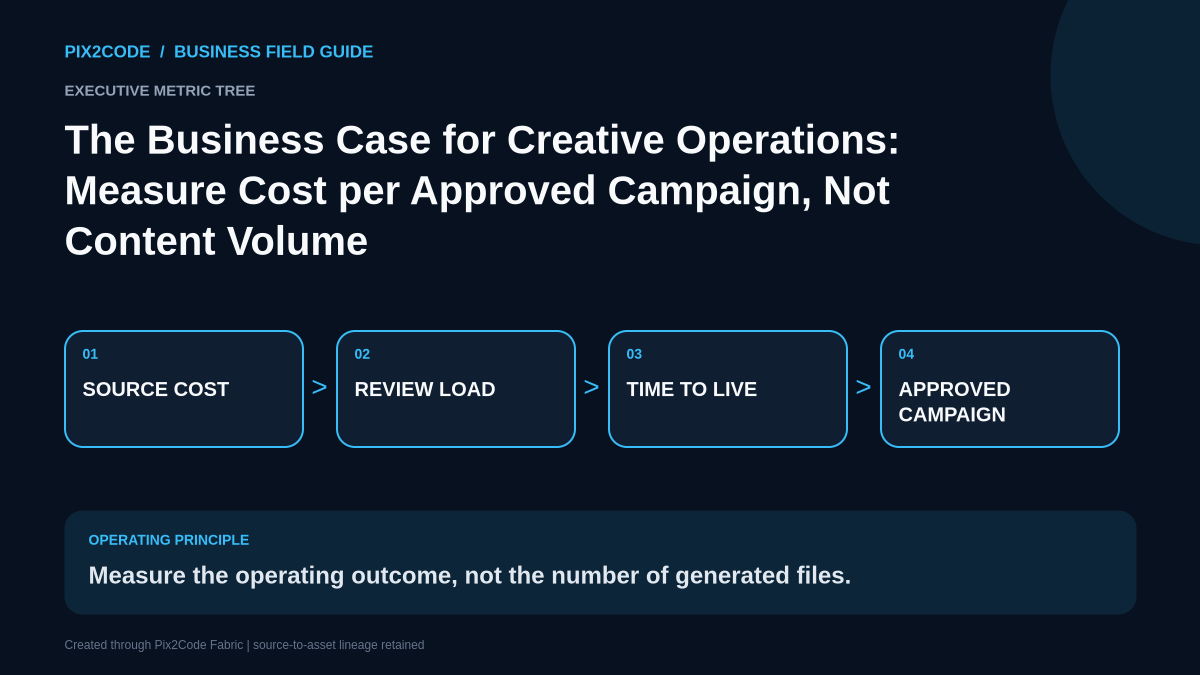
When presenting your creative operations ROI case, an Executive Metric Tree infographic can be highly effective. This visual asset illustrates the cascading impact of operational metrics on business outcomes. It clarifies how improving cycle time or reuse rates contributes to overall financial goals. While not linked here, consider developing such a visual.
Your Next Strategic Move
For CMOs, VPs of Growth, and Heads of Demand Generation, the imperative is clear. Evaluate your current creative workflow before adding another tool. Understand your baselines for cycle time, rework, and approval costs. Only then can you make an informed decision on investments that truly impact your cost per approved campaign and drive measurable growth.