Audience intelligence | Pix2Code Editorial
Turn First-Party Audience Signals into Better Content Briefs
The Disconnect: From Audience Data to Actionable Content
Growth leaders, CMOs, and Heads of Demand Generation face a critical challenge. Their content volume often feels disconnected from tangible revenue outcomes. Audience research often lives in dashboards while content briefs fall back to generic personas and broad channel assumptions. This gap prevents insights from truly driving production. Performance data also arrives too late to guide the next content brief effectively.
The core operating decision at stake is how to bridge this chasm. How do we move from insightful reports to content that demonstrably moves the needle? The answer lies in a more integrated approach. We must connect audience signals directly into our content creation process.
The Challenge of Static Personas
Generic personas, while a starting point, rarely capture the dynamic nuances of a target audience. They often lead to content that is broad and uninspiring. This results in wasted effort and content that fails to resonate. For brand marketing, creator media, and B2B software companies, this inefficiency is costly. It impacts qualified evaluation and organic search performance.
Building a Smarter Content Decision Loop
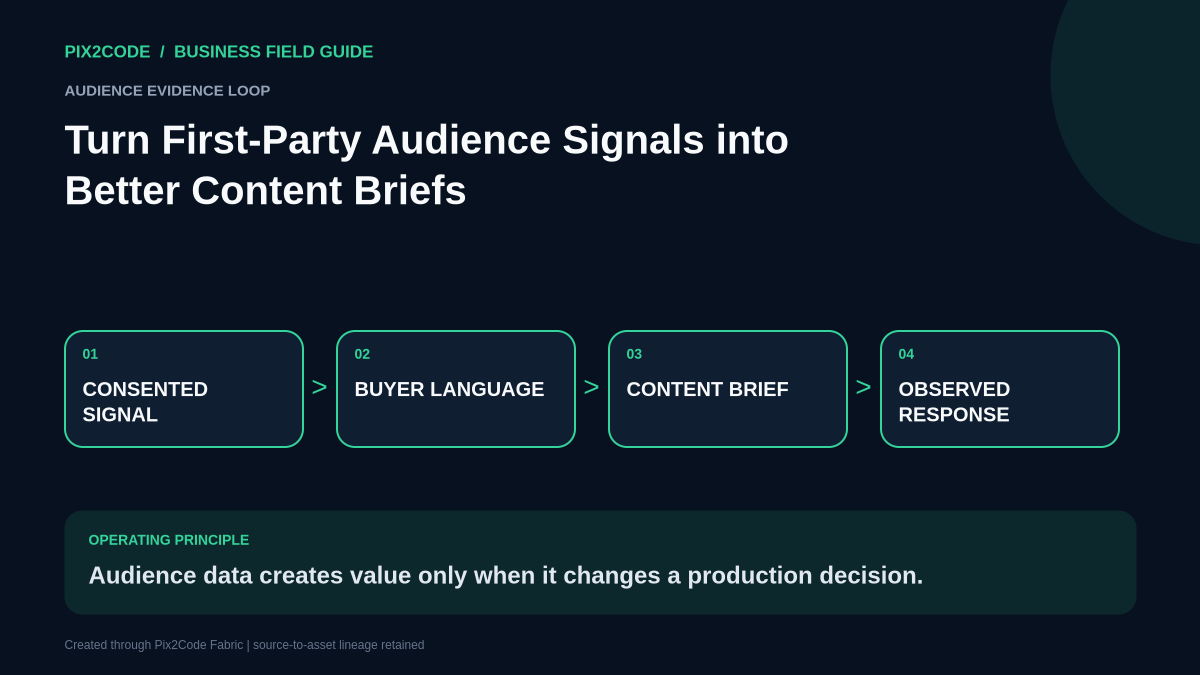
A truly effective content operation requires a connected decision loop. This loop integrates consented audience signals, company research, buyer language, story selection, creative hypotheses, and post-launch learning. This approach replaces assumptions with evidence, driving better outcomes. It shifts focus from volume for its own sake to content that converts.
#### Capturing and Activating First-Party Audience Data
First-party audience data is proprietary information collected directly from your audience. This includes website interactions, product usage, and direct feedback. Activating this data means moving it beyond isolated dashboards. It must inform every stage of your content workflow. This is fundamental to building a data-driven content brief. It ensures content addresses real needs, not just assumed ones.
#### Translating Company Research into Relevant Stories
Understanding your audience also involves deep company research. This includes understanding their business context, market pressures, and strategic priorities. This research helps craft stories that speak directly to their challenges. It moves content beyond feature lists to solutions that resonate. This approach builds trust and relevance with operating leaders.
#### Understanding Buyer Language and Intent
The words your buyers use reveal their true intent and pain points. Incorporating authentic buyer language into your content is crucial. This means listening to sales calls, reviewing support tickets, and analyzing customer feedback. Such language makes content feel personalized and directly addressable. It helps content cut through the noise.
#### Developing Evidence-Backed Creative Hypotheses
Great content isn't just about good writing; it's about testable ideas. A strong content brief includes clear creative hypotheses. These are informed by first-party audience data and buyer language. For example, "Content addressing X pain point with Y solution will drive higher engagement." These hypotheses allow for systematic learning and optimization. They provide a clear direction for creative teams.
#### Connecting Performance Learning to Future Briefs
The learning loop must be closed. Performance data should not be an afterthought, arriving too late to matter. Instead, it must feed directly into the next content brief. This iterative process refines your audience intelligence content strategy. B2B content research highlights this necessity. It identifies creating action-driving content, aligning with the buyer journey, measurement, and sales-marketing alignment as linked challenges. Source. This ensures continuous improvement and relevance.
Realigning Content Briefs to Business Outcomes: A Diagnostic
For CMOs, VP Growth, and Heads of Demand Generation, aligning content with revenue is paramount. A diagnostic approach can reveal workflow weaknesses. It helps identify where audience insights do not reach production teams effectively. It also shows where performance data arrives too late to guide the next brief.
Diagnostic Checklist for Actionable Briefs
This checklist helps evaluate your current content brief process. Each item requires a concrete question or action.
- Does your content brief explicitly link to a specific revenue goal or business outcome?
- Are the latest first-party audience data insights directly accessible to your content creation team?
- How quickly do performance metrics from launched content inform adjustments to the next data-driven content brief?
- Is there a clear, documented process for incorporating authentic buyer language into creative mandates?
- Do your content briefs include testable creative hypotheses based on identified audience pain points?
- What mechanisms ensure company research influences story selection, not just broad topic areas?
A Framework for Data-Driven Content Briefs
Moving to an evidence-led content operation requires a new framework. This framework guides content decisions with clarity and measurable outcomes. It provides a structured approach for operating leaders.
Content Decision Framework
| Decision Point | Current State (Problem) | Desired State (Solution) | Key Input | Outcome Metric |
|---|---|---|---|---|
| Audience Understanding | Generic personas, broad assumptions | Evidence-backed first-party audience data | Consented audience signals | Brief-to-conversion rate |
| Content Direction | Topic-driven, unvalidated ideas | Buyer language-informed stories, specific pain points | Company research, buyer language | Engagement per content piece |
| Creative Hypothesis | Instinct-driven creative | Testable creative hypotheses based on insights | Audience pain points | A/B test lift, CTR |
| Performance Loop | Late data, disconnected from future briefs | Real-time feedback, iterative brief refinement | Post-launch learning | Content-influenced pipeline, sales velocity |
Integrating Intelligence: Where Pix2Code Fits
Implementing a truly integrated audience intelligence content strategy demands capable tooling. This is where AI content operations platforms become essential. They help orchestrate a seamless source-to-campaign workflow.
Connecting Signals to Campaigns with Pix2Code
Pix2Code provides a connected implementation path for these strategies. Its Prospect Engine is designed to profile companies, discover competitors, and synthesize evidence-backed buyer personas for downstream work. This capability directly addresses the pain point where audience insights do not reach production teams. It ensures that first-party audience data informs every creative decision. This builds a robust creative decision lineage.
Supporting Your Strategic Shift
Transitioning to a data-driven content operation is a strategic initiative. Visual frameworks can help communicate the shift. Consider reviewing an "Audience evidence decision loop" infographic. This visual asset clarifies how each piece of audience intelligence connects. It illustrates the flow from data capture to content activation and learning.
Your Next Strategic Action
For CMOs, VP Growth, and Heads of Demand Generation, the path forward is clear. Before investing in new tools, evaluate your current workflow. Understand where your first-party audience data breaks down. Identify why audience insights do not reach production teams. Pinpoint why performance data arrives too late to guide the next brief. A thorough assessment will reveal the true opportunities for improvement. This focused evaluation will inform more effective investments. It ensures that any new solution truly solves your operational challenges.